Summoned
Following Jesus into God's empire.

This sermon was preached at Catonsville Presbyterian Church, Catonsville, MD, on February 1, 2026. My text is Matthew 4:12-25. Here’s a link to the Gospel reading. The sermon was followed by a celebration of the Lord’s Supper, hence the reference to the table at the end.
Whenever we read the New Testament, from Matthew to Revelation, we need always to keep the Roman Empire in view. It’s the context for every text. Every Gospel and letter, all of it was written by, to, and for a people living in and oppressed by one of the largest superpowers the world had ever known. During Holy Week, we talk about the empire. It’s kind of tough not to, since Jesus was executed on a Roman cross. But don’t be fooled. Rome is everywhere.
Luke’s Gospel is more explicit about Rome’s presence. “In those days a decree went out from Caesar Augustus” (Lk 2:1). All the titles given to Jesus by the angels to the shepherds abiding in the fields—Savior, Lord, bringer of peace—were all first ascribed to Augustus. (Lk. 2:8-14). It was Caesar who brought good news of great joy, tidings of great joy—or so said imperial propaganda. In the Roman Empire, good news, euaggelion, or gospel, was a political term for major announcements, such as the emperor’s ascension, military victory, or birthday, signifying peace and divine favor.[1]
In Matthew’s Gospel, we have to work a little harder to see Rome, but once you see it, you can’t unsee it. “Now when Jesus heard that John had been arrested,” Matthew says (Mt. 4:12). Arrested by whom? Herod Antipas (20 BC–c.39 AD) was the Roman ruler of Galilee and Perea.[2] Jesus, because he was associated with John’s ministry (and they were cousins), withdrew to Galilee.
Now, Galilee was not this bucolic, pastoral region around a lake. The Roman oppression, through taxation, was particularly severe in Galilee. The Romans brutalized, demoralized, persecuted, enslaved, and murdered the Jewish people there. And the fishing industry, in particular, was all controlled by Rome to satisfy the empire’s insatiable desire for salsamentum, stews of pickled or salted fish heads, a highly valued condiment and all-purpose medicine, which was heavily taxed, meaning that life for Peter and Andrew, for James, John, and their father’s fishing business was taxing indeed.[3] Matthew tells us what it was like in Galilee. Matthew turns to the words of Isaiah (Is. 9:1-2) to describe his experience under Roman occupation: “On the road by the sea, across the Jordan, Galilee of the Gentiles—the people who sat in deep darkness” (Mt. 4:15). But fear not, “…for the people who walked in darkness have seen a great light,” said Isaiah. “And for those who sat in the region and shadow of death light has dawned.”
And what does Matthew then tell us? “From that time Jesus began to proclaim, ‘Repent, for the kingdom of heaven has come near’” (Mt. 4:17). That time, the time of Rome, the time of oppression, the time of darkness, is about to see the emergence of light, a new light coming into the world. Jesus comes preaching, proclaiming, announcing that we need to reframe our thinking, and our perceptions of power and empires, reframe our understanding of the world, which is what repent (metanoiete) means. “Repent” means to wake up, it means to change your perspective, it means to step out from the old framework, the old way of understanding the world, meaning the realm of Caesar’s empire, and know that a different kingdom, a different empire has come near, “at hand” and on hand.
Matthew uses the phrase “kingdom of heaven.” “Heaven” does not mean “up there” or the place we go when we die. Because Matthew was written to a Jewish audience, it’s a way to refer to God without saying the name. Mark’s Gospel reads “kingdom of God.” Both Matthew and Mark, along with Luke, are talking about the same thing. This kingdom – basileias in Greek meaning realm or, better, empire—is here, at hand, in him.
Just consider what this means. This means that within the Roman Empire, Jesus comes preaching about another empire, God’s empire, working like yeast in bread (Mt. 13:33). Indeed, the central theme of Jesus’ teaching and ministry is the inestimable value of God’s empire; it’s the “pearl of great price” (Mt. 13:45-46). It’s why Jesus tells us to seek first after God’s empire (Mt. 6:33). It’s also the message that gets Jesus and his followers into trouble—good trouble—with the powers that be, because empires have a habit of being seduced into thinking that only might makes right. Empires don’t want to hear anything so “weak” as the idea that right makes might. It is the right, meaning the good, God’s good or righteousness or justice that makes might, has might. And God’s might is a different kind of might, which, from the perspective of other empires, appears as “weak.” But as Paul knew personally, God’s power is made perfect in weakness (2 Cor. 12:9). It’s the kind of power that King Jesus wielded in weakness on a Roman cross.
The way of God’s empire cost Jesus his life, but as those fishermen knew that day when he summoned them to follow, follow him and walk with him into a new empire, God’s way is the way that brings life, true life, that still more excellent way that Paul talked about (1 Cor. 12:31). And when you have a glimpse of that way, as I believe those fisherfolk heard and felt and sensed in Jesus, an altogether different life, a light shining in dark times, they were willing and open to leave everything behind without know what the future might bring, just to be able to go with him, to walk with him, to follow in a way that was so weird and good and holy compared with anything they had ever received or experienced from Rome. It’s the way of love, deep, profound suffering love, the kind of love that suffers with and for, on behalf of the other, whomever the other might be.
Jesus summons them to walk with him, to follow in his way, and step into the realm, the empire of God. What does life look like in God’s realm? It’s the realm of fairness, justice, and righteousness; it’s God’s way of mercy and grace and peace and fierce love. It’s where God’s judgment falls upon evil and every injustice in the world that corrupts and harms and destroys life. In God’s realm, we see God’s redemptive power to heal and to restore, to save and to make whole. This kingdom, this kin-dom, this realm, this empire, this sphere of benevolent influence has come near, has drawn close to us in Jesus of Nazareth, and whenever we are near him, then, we too, know the kingdom is at hand. All that the kingdom symbolizes and means is embodied in Jesus, in what he says, but also in what and who he is.
And then Matthew tells us in the verses that follow that “Jesus went throughout Galilee teaching in their synagogues and proclaiming”—here we go, pay attention to this, listen to this—“the good news of the kingdom” (Mt. 4:23)— euaggelion tes basileias (εὐαγγέλιον τῆς βασιλείας). Jesus’ listeners (and all those reading Matthew’s Gospel) would have heard the radicality of this message. Not Rome’s “good news,” which is really bad news, fake news, but God’s good news. Matthew intentionally uses Roman imperial language and says, “No.” Jesus reframes and redefines the meaning of good news and empire. What Rome offers is the equivalent of Orwellian “newspeak.”[4] The good news of Caesar is not good—which means the church must always be wary of any voice that tries to confuse, conflate, or combine God’s empire with any other empire.
The gospel or good news of Jesus calls us into a new way, the way of wholeness. Continue reading in Matthew 4, and you see that Jesus begins his ministry with healing, which is a symbolic way of saying that his way is the way that liberates us from that which binds us, restoring health and wholeness and relationships and communities and pulling people together. That’s why what Jesus offered, and offers still, is true good news.
The Roman Catholic theologian, Alfred Loisy (1857–1940), writing in 1903, said,
“Jesus came proclaiming the Kingdom, and what arrived was the Church.”[5]
That statement got him into trouble with the Vatican. It’s a harsh indictment of the Church, but I think there’s a lot of truth to it. Jesus announced the kingdom and summoned us to risk following him into it and to live from it. The church only exists to serve the kingdom of God. The Anglican bishop and ecumenist Lesslie Newbigin (1909-1998) captured this spirit when he said,
“The church is not meant to call men and women out of the world into a safe religious enclave, but to call them out in order to send them back as agents of God’s Kingdom.”[6]
Agents of God’s Empire, that’s what you and I are. If you’re baptized, that’s what we’ve been baptized into.
When we say yes to Jesus—again and again throughout our lives—when we say yes to the call to walk in his way, we should not be surprised that we meet resistance. For as the long history of the Church has shown, we really don’t know what to do with God’s way of righteousness, justice, and love. That’s why we need to stay close to him and to those found in him. Community essential. So, Jesus gives us this meal: bread and wine. This is the table of God’s empire. Jesus himself told us that people will come “from east and west, and from north and south” (Lk. 13:29) to sit at table in God’s empire. And so we have. This is the place where we, followers of Jesus, meet our Lord, meet as Friend, our Friend indeed (as the old hymn says),[7] who daily revives us and prepares us for the holy work he’s calling us toward.
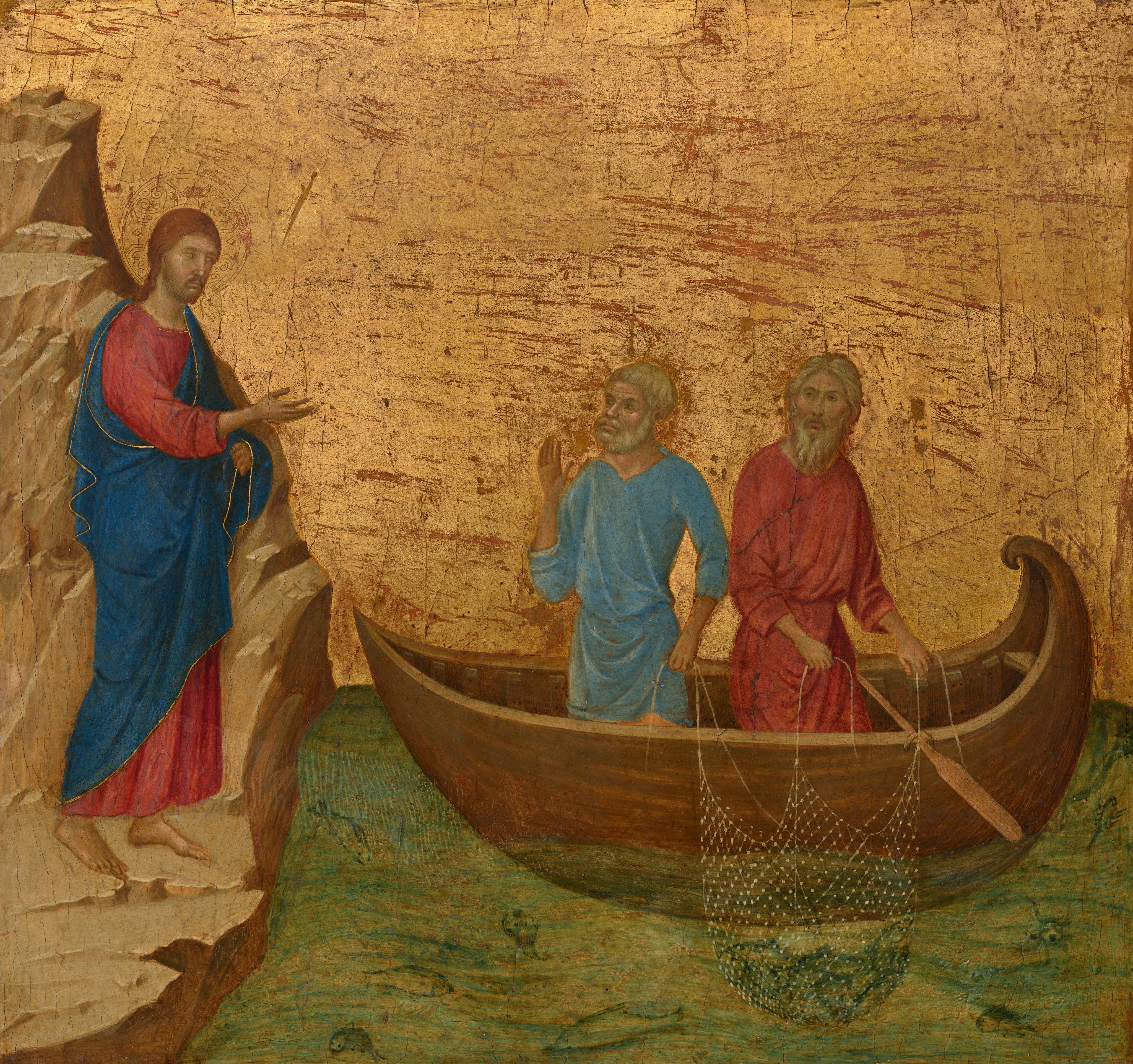
Image: “The Calling of Sts. Peter and Andrew” (1308-1311) by Duccio di Buoninsegna (c.1250/1255 – 1318/1319), National Gallery of Art, Washington, D.C.
[1] On Jesus, the early followers of Jesus, and the Roman Empire, see Richard A. Horsley, Jesus and Empire: The Kingdom of God and the New World Order (Fortress Press, 2003), as well as Jesus and the Powers: Conflict, Covenant, and the Hope of the Poor (Fortress Press, 2011).
[2] Herod Antipas, son of Herod the Great (c.72–c.4 BCE), served as tetrarch, appointed by emperor Augustus to rule over one quarter of his father’s kingdom. Herod Antipas is mostly known as the Herod for whom Salome danced and who ordered the beheading of John the Baptist. See Matthew 14:3-12.
[3] Urban populations throughout the Roman Empire came to love the spicy, smelly fish sauces known as garum and salsamentum. See Richard A. Horsley and Neil Asher Silberman, The Message and the Kingdom: How Jesus and Paul Ignited a Revolution and Transformed the Ancient World (Fortress Press, 1997), 25.
[4] George Orwell (1903-1950) introduced the term “newspeak” in his dystopian novel and cautionary tale, 1984, first published in 1949. Orwellian describes a situation in which language is distorted for political and controlling purposes.
[5]Alfred Loisy, L’Évangile et l’Église (The Gospel and the Church), published in 1903.
[6] Lesslie Newbigin, The Gospel in a Pluralist Society (Eerdmans 1989).
[7] “My Song is Love Unknown,” composed by John Ireland (1870–1962) in 1918, is a setting of Samuel Crossman’s (1623-1683) poem from 1664: “He came from His blest throne/ salvation to bestow;/ but men made strange, and none/ the longed for Christ would know./ But oh, my Friend, my Friend indeed,/ who at my need His life did spend!”
How well this sermon speaks to what is going on in our world today. It was perhaps the spark that my hope needed. I also resonated with the points on the church’s role in God’s Kingdom. I cannot control how others view God’s Kingdom but if I can focus on his kingdom, there is my light and hope.